

The most advanced model in the world produces mediocre results if the data and knowledge you give it are incomplete, duplicated, or obsolete. Data readiness is often the real bottleneck—not the choice of model.
What “ready data” means in practice
It does not mean “having a perfect data lake”. It means, for the scope you want to automate or assist:
- critical information exists and is findable;
- there is a recognizable current version;
- access is coherent with risk;
- sources are citable and maintainable;
- quality is sufficient for the reliability level you need.
Gartner and other 2025–2026 analyses continue to point to data quality and availability among the main causes of AI project abandonment. Without this base, the pilot looks brilliant and production does not.
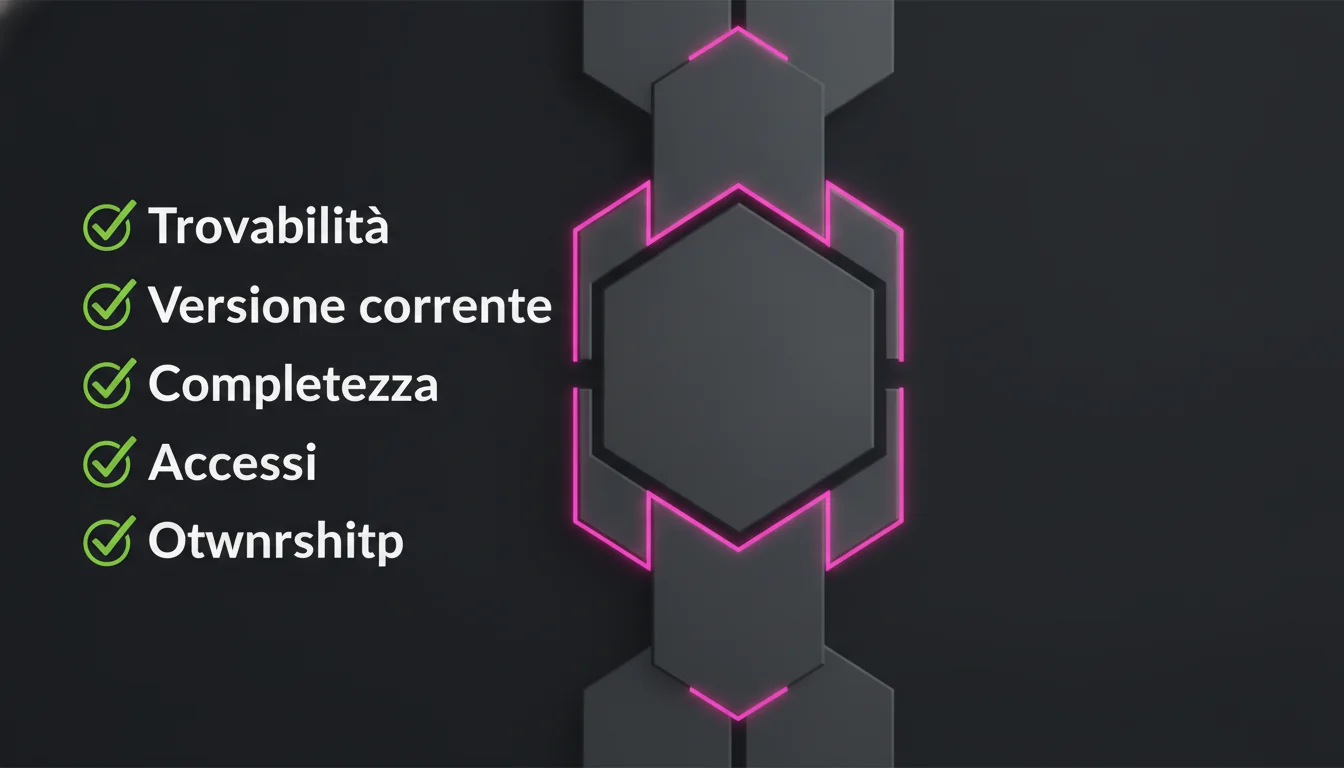
An operational six-point checklist
-
Findability
Can people (and systems) find the right document or data in acceptable time? -
Current version
Is there a clear golden source, or do three versions of the same file coexist? -
Completeness for the use case
Is all information needed for the process present, or are critical pieces missing? -
Accessibility and permissions
Who should see what? Are rights aligned with risk? -
Update and ownership
Who is responsible for keeping that knowledge current? -
Citability and verifiability
Can AI (or a person) indicate where the information comes from?
If more than two points are weak on a process, the AI project will start uphill.
Why SMEs suffer more (and how to limit the damage)
In SMEs, critical knowledge often lives in:
- messy shared folders;
- email and chat;
- people’s heads;
- unofficial working Excel files.
You do not need to fix everything. You need to fix the scope of the first use case.
The method that works:
- Choose a process.
- List the 10–20 documents or sources that feed it.
- Put order only on those (versions, owner, access).
- Only then connect AI.
This is also the through-line of the Zendata series: usable knowledge before the tool.
Signals that data is not ready
- AI answers are plausible but “do not match” operational reality.
- People keep asking colleagues “which is the good version”.
- The pilot only works with hand-selected data.
- You cannot cite sources reliably.
FAQ
Do you need months of data cleaning?
No. Start from the use-case scope. Prove value and expand.
Are structured data (ERP/CRM) enough?
Rarely. Decision and procedural knowledge often lives in unstructured documents.
Can AI help put things in order?
Yes, it can support finding duplicates, classification, and suggestions. Human responsibility for versions and decisions remains necessary.
When is data “ready enough”?
When, on that process, answers become citable, verifiable, and useful in daily work—not only in a demo.
Sources
- Gartner and 2025–2026 analyses on data readiness and AI project abandonment.
- Istat Enterprises and ICT 2025: adoption context and barriers.
- Papers and practice on RAG and corpus quality (Lewis et al. and later work).
Dig deeper in the series
- Document management and AI
- Dematerialization, compliant archive, and AI
- Not which AI to choose: which knowledge to make usable
- When AI is wrong: the problem is often the context
If you want a quick readiness assessment on a specific process (documents, access, versions, gaps), we start there. Write to info@zendata.it or visit zendata.it.
Pietro Ciattaglia, CEO of Zendata AI, Rome