

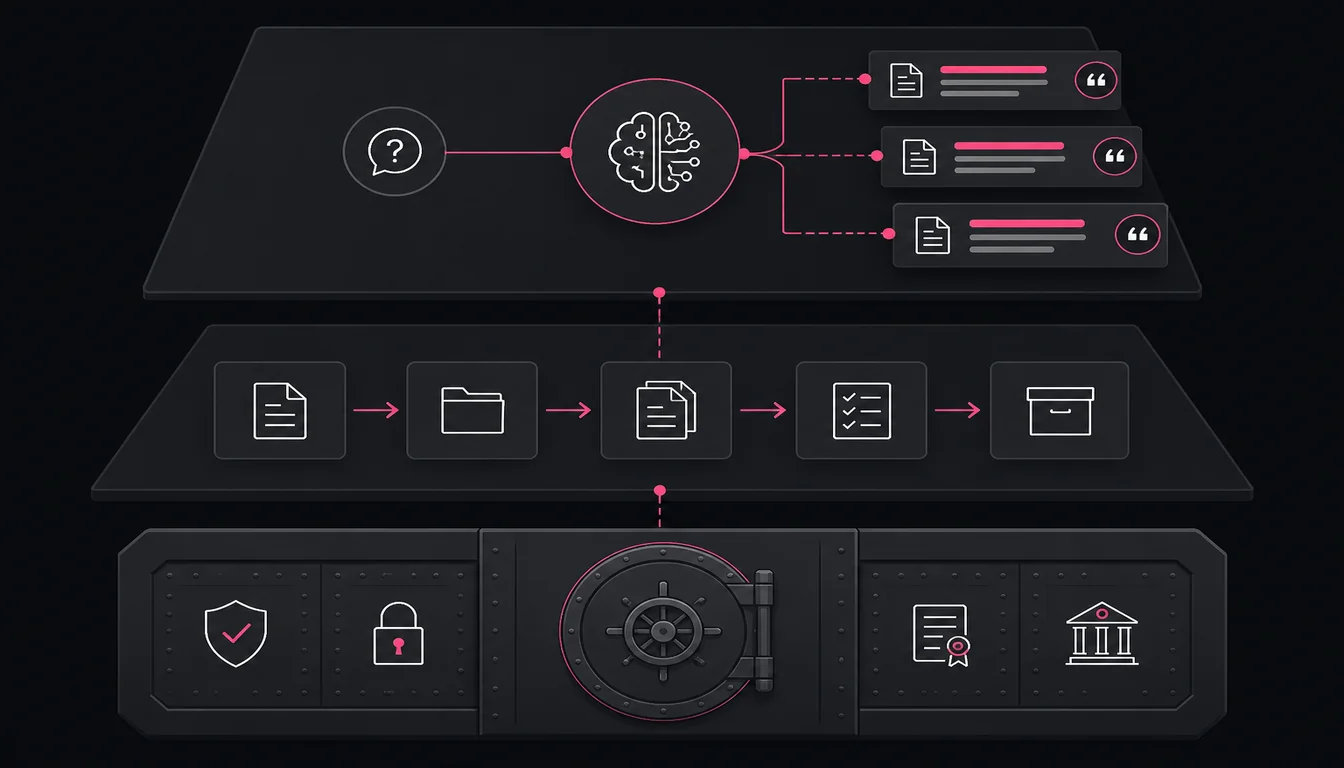
Dematerialization replaces paper with legally equivalent electronic copies; it does not, by itself, make documents queryable by AI. Legally compliant preservation, a document management system (DMS), and a knowledge base with RAG (Retrieval-Augmented Generation) are three distinct layers. Mixing them up produces “dead” archives: barely searchable, weak in an audit, useless for a company assistant.
General information, not legal advice.
What dematerialization is (and is not)
Dematerialization is the move from analog documents to electronic copies that must have the same content and form as the original, using processes and tools that guarantee it. AgID guidelines on creating, managing, and preserving electronic documents tie this to image copies and, for bulk dematerialization, to certified processes.
It is not “scan everything to PDF and put it on a disk”. That is, at most, a first digitization step.
For public administrations, Article 42 of the Digital Administration Code (Legislative Decree 82/2005) requires a cost–benefit assessment of recovering paper records that must or should be kept, and plans to replace paper archives with electronic ones, following the guidelines.
In private companies the driver is often tax and operations (e-invoicing, paperless processes), not the same duty as in the public sector. The distinction stays: legal equivalence of the copy ≠ usable knowledge.
Compliant preservation: storing files is not “putting them somewhere”
Digital preservation (often called substitute or “a norma” preservation in Italy) is a regulated process: it must protect integrity, authenticity, readability, and retrievability over time. The MEF decree of 17 June 2014 sets how tax duties on electronic documents and their reproduction on different media are fulfilled.
In practice you need formats and procedures (for example submission packages, signatures, time validation) and, in an audit, the ability to exhibit a readable document. A PDF in a shared folder, even “in the cloud”, is not automatically a compliant archive.
AI does not replace this layer. It can search a corpus; it does not sign, time-stamp, or certify exhibition.
Why a “dead” digital archive does not feed AI
An archive is “dead” for AI when files exist but are not a corpus: scans without extractable text, missing metadata, three versions of the same contract, incoherent permissions, no origin trail.
It usually happens for four reasons:
- Image only, little text. Image-only PDFs need OCR. Extraction errors and missing structure become wrong context at generation time.
- Weak metadata. Without date, owner, document type, VAT number, or a search key, semantic retrieval picks poorly. AgID guidelines insist on metadata because without it an electronic document is hard to manage and find.
- No current version. The assistant answers from the 2019 procedure while production uses the 2025 one.
- Rights and provenance. Documents with personal or confidential data cannot be dumped into a model without a legal basis and access controls. The GDPR remains the framework for processing; in a RAG system, without a source pointer, you cannot show where a claim came from.
The original RAG paper describes the mechanism: external memory retrieved at question time. If what you retrieve is unreadable or wrong, the model “reasons” over garbage.
According to Istat, Enterprises and ICT 2025, among firms with at least 10 employees that considered AI and did not adopt it, poor quality or unavailability of data is an obstacle for 45.2%. That is why many pilots stay demos.
DMS and knowledge management are not the same thing
| Document management (DMS) | Knowledge management (ISO 30401) | |
|---|---|---|
| Goal | Flow, classification, access, document compliance | Create value from knowledge (explicit and tacit) |
| Typical content | Invoices, contracts, protocol, formal email | Procedures, know-how, lessons learned, training |
| Processes | File life cycle: create, store, preserve | Capture, share, reuse, learn |
| Reference | CAD / AgID guidelines (public sector), ISO 9001 on documentation, privacy | ISO 30401:2018 |
A DMS (SharePoint, ECM, Italian protocol platforms) is needed for order and audit. It is not, by itself, a knowledge-management system: you still need ownership of knowledge and, for AI, a scope that is readable, current, accessible, and citable.
What to do in practice (without rebuilding the whole company)
Italian firms already have a lot of “mandatory” digitization. In 2025, 68.1% of enterprises with at least 10 employees buy intermediate or advanced cloud, and 88.3% of SMEs reach a basic digitalization level (EU target 90% by 2030). AI use in SMEs is 15.7%, versus 53.1% in large firms (Istat 2025). In 2023 Italy was already a pioneer on e-invoicing: 97.5% of 10+ firms versus 38.6% in the EU27 (Istat, Enterprises and ICT 2023). Infrastructure yes; queryable knowledge, often no.
On a single process:
- Separate what must be preserved under the rules (invoices, ledgers, acts to exhibit) from what must be usable (procedures, operating contracts, internal FAQs).
- For the AI scope: extractable text, current version, minimal metadata, permissions aligned with risk.
- Only then connect retrieval and generation. Measure search time, % of answers with a source, human corrections.
Zendata starts from this order: compliance and archive where they are required; a usable corpus where AI must answer. We do not sell “dematerialization in a box”: no software produces it without procedures.
FAQ
What is document dematerialization?
It is replacing paper documents with electronic copies that, if produced under the technical rules, have the same content and form as the original. For Italian public bodies, CAD Art. 42 requires a cost–benefit assessment of moving from paper to electronic archives. It is not the same as “dropping PDFs in a folder”.
What is the difference between dematerialization and digitization?
Digitization is the broader shift to electronic documents. Dematerialization stresses replacing paper with legally equivalent electronic copies. An archive full of scans can be “digitized” without being dematerialized under the rules.
Is legally compliant preservation enough to use AI on documents?
No. Compliant preservation protects integrity, authenticity, readability, and retrievability over time. AI, typically via RAG, searches and summarizes: it does not confer legal validity, and it fails without extractable text, metadata, a current version, and permissions.
Is a DMS a knowledge-management system?
No. A DMS manages the document life cycle. Knowledge management, including ISO 30401, covers capturing, sharing, and using knowledge. A DMS can feed a knowledge base; it does not replace it.
Does AI give legal validity to company documents?
No. A RAG assistant can cite a file stored under preservation rules, but it does not replace substitute preservation, signatures, or tax exhibition.
Sources
- AgID: Guidelines on electronic documents
- CAD, Art. 42 — dematerialization of public-body documents
- MEF decree 17 June 2014 — tax duties on electronic documents
- Istat: Enterprises and ICT, 2025
- Istat: Enterprises and ICT, 2023 — e-invoicing 97.5%
- ISO 30401:2018 — Knowledge management systems
- Lewis et al.: Retrieval-Augmented Generation (arXiv:2005.11401)
- GDPR — Regulation (EU) 2016/679
More in the series
If you want to separate, on one concrete process, what must be preserved under the rules and what must be queryable, we start from sources, versions, and access. Write to info@zendata.it or visit zendata.it.
Pietro Ciattaglia, CEO of Zendata AI, Rome