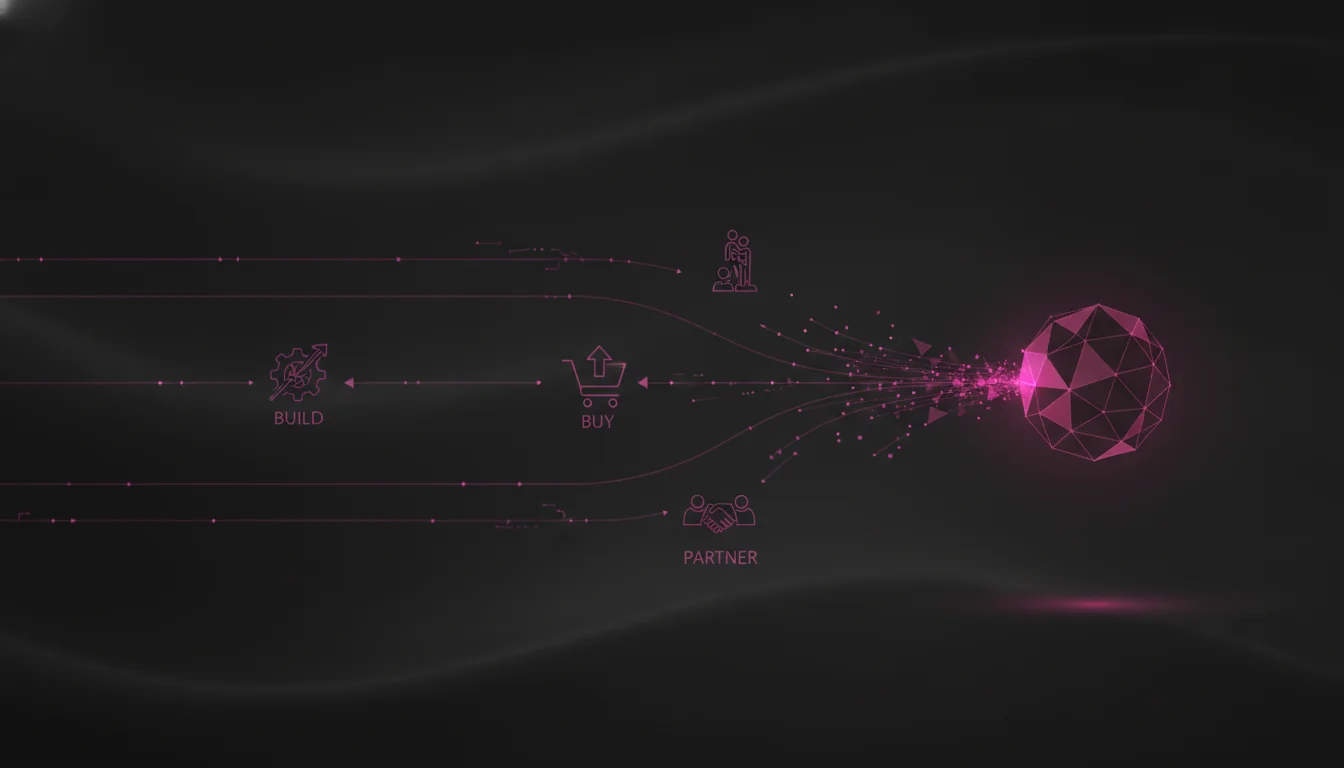
The question “do we build or buy?” is often poorly framed. For most SMEs the real choice is among three options: internal build, buy a product, or partner for solution + capability. Each has different costs, risks, and speed.
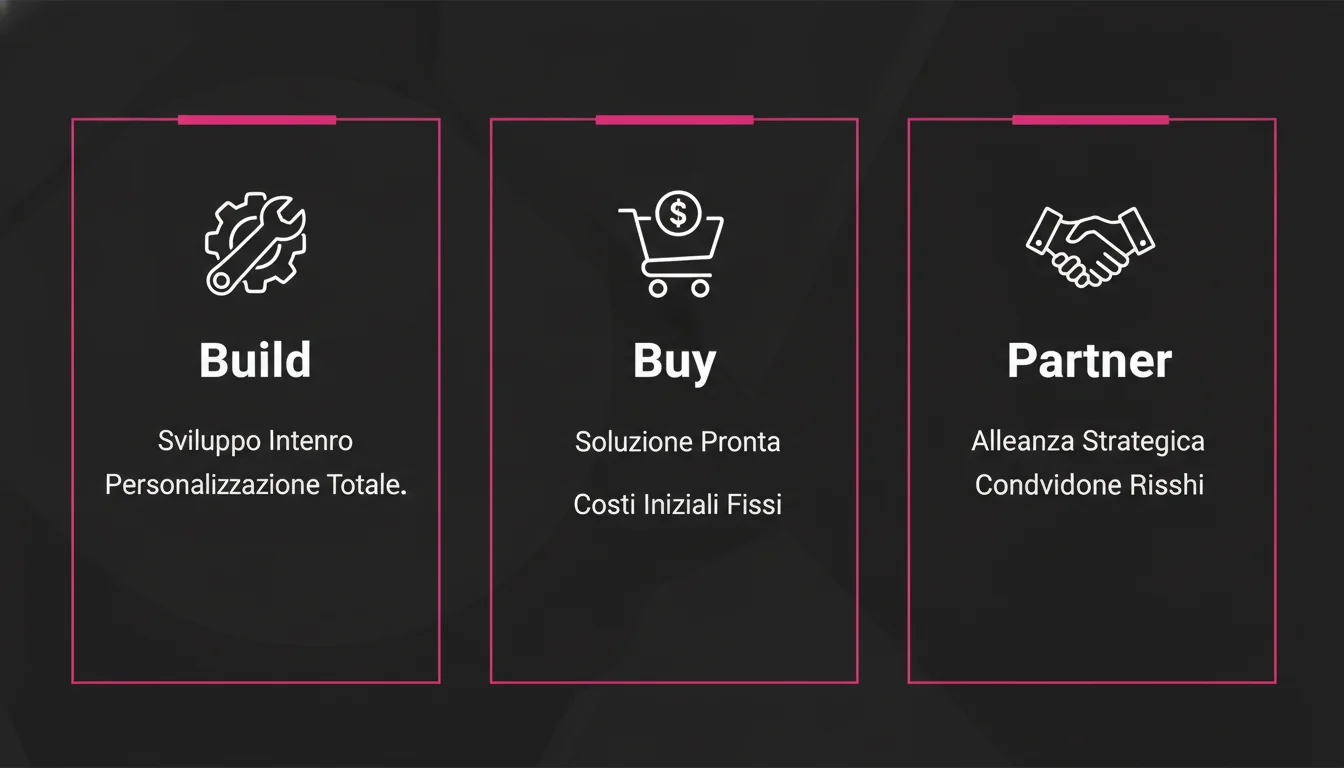
The three paths (and when they make sense)
1. Internal build
Makes sense when:
- the use case is strongly proprietary and strategic;
- you have stable internal skills;
- you are willing to invest time in maintenance and evolution.
Typical risk: underestimating the cost of ownership (data, integration, monitoring, updates).
2. Buy (ready product)
Makes sense when:
- the problem is standard (e.g. generic copilot, basic document search);
- you want speed and a vendor that manages model evolution;
- the risk perimeter is clear and acceptable.
Typical risk: lock-in, poor fit to your document and process context.
3. Partner (solution + capability)
Makes sense when:
- you want an operational result on a concrete process;
- you do not (yet) have complete internal skills;
- you prefer a guided path with know-how transfer.
Typical risk: dependency if ownership transfer is not designed from the start.
Orders of magnitude: time, cost, control
Indicative numbers for an SME on a first concrete perimeter (knowledge assistant or narrow document process). These are not price lists: they help compare the three paths with the same unit of measure.
| Approach | Typical time to first observable value | 12-month ownership cost, order of magnitude | Control over process and data |
|---|---|---|---|
| Buy (generic SaaS) | days–a few weeks | €2,000–€15,000 (seats + connectors; grows if you customise) | low–medium: suited to standard cases |
| Partner (solution + capability) | 6–12 weeks on a closed perimeter | €15,000–€35,000 setup + run (often hundreds to a few thousand €/month) | high if ownership and metrics are in the agreement |
| Build in-house | 6–18 months to production quality | often €60,000+ (team, infra, monitoring, technical debt) | maximum, if skills stay in-house |
Custom-agent setup bands (PoC €3–8k, production-ready €15–35k, ERP/actions €35–60k) are in How much a custom AI agent costs for an Italian SME in 2026. They are not a Zendata price list: they stop you comparing a few SaaS seats with a one-year internal build.
In Zendata “partner on knowledge / document intelligence” projects, useful signals at 30–60 days are typically: adoption on the official channel, share of citable answers, and shorter search time on recurring questions — not “the model is newer.”
Anonymized decision example.
An organization with thousands of procedure pages (order of 6,000+) could buy a generic copilot in a few days, but without reliable citation of internal sources and without ACLs. It chose a partner path: authenticated assistant, ingestion pipeline, citable sources. Buy remained useful for individual productivity; partner was needed for the company process.
A five-question decision framework
-
How specific is our process?
Very specific → build or partner. Standard → buy. -
How critical is the risk (data, decisions, compliance)?
High → you need strong control and governance (often partner or build with controls). -
Do we have stable internal skills?
No → buy or partner. Yes → build becomes more realistic. -
What is the time horizon for value?
Need a result in weeks/months → buy or partner. Long strategic horizon → build can pay off. -
Do we want capability transfer?
Yes → a well-structured partner. No → pure buy.
Frequent mistakes in SMEs
- Starting from “we must have an internal AI team” without a use case that justifies it.
- Buying a generic product and discovering it does not speak to real documents and processes.
- Delegating everything to a partner without defining ownership and success metrics.
- Underestimating the cost of keeping alive what you have built.
How to choose in practice
- Define the first (or next) use case in terms of process and metrics.
- Evaluate the three paths with the five questions above.
- Prefer the option that maximizes the chance of reaching production with clear ownership.
- If you choose a partner, include know-how transfer and metrics in the agreement from the start.
At Zendata we typically work as a partner: we deliver an end-to-end solution on a concrete scope and build the conditions for the company to govern it over time.
FAQ
Is it always better to build in-house?
No. Only if competitive advantage and skills justify it. Many SMEs get more value faster with targeted buy or partner options.
Is an AI SaaS product enough?
It depends on the use case. For individual productivity, often yes. For processes that use proprietary knowledge and require accountability, you usually need more than a generic tool.
How do you avoid partner dependency?
Define internal ownership, documentation, metrics, and a handover plan from the start. A good partner proposes this themselves.
How much does it cost to compare the three options?
A 1–2 week assessment on a concrete use case costs far less than a wrong project. A typical closed-scope partner project, in 2026 market bands, sits around €15,000–€35,000 (6–12 weeks). Detail: How much a custom AI agent costs for an Italian SME in 2026.
Sources
- Practice and surveys 2025–2026 on make-or-buy of AI in enterprise and mid-market.
- McKinsey State of AI: correlation between approach and impact.
- Operational experience on SME projects (recurring success and failure patterns).
Dig deeper in the series
- Where to start with AI in the company
- From pilot to production
- How much a custom AI agent costs for an Italian SME in 2026
- How to measure AI ROI
If you want a structured Build / Buy / Partner evaluation on a use case in your company, we can run a priority and criteria session. Write to info@zendata.it or visit zendata.it.
Pietro Ciattaglia, CEO of Zendata AI, Rome