
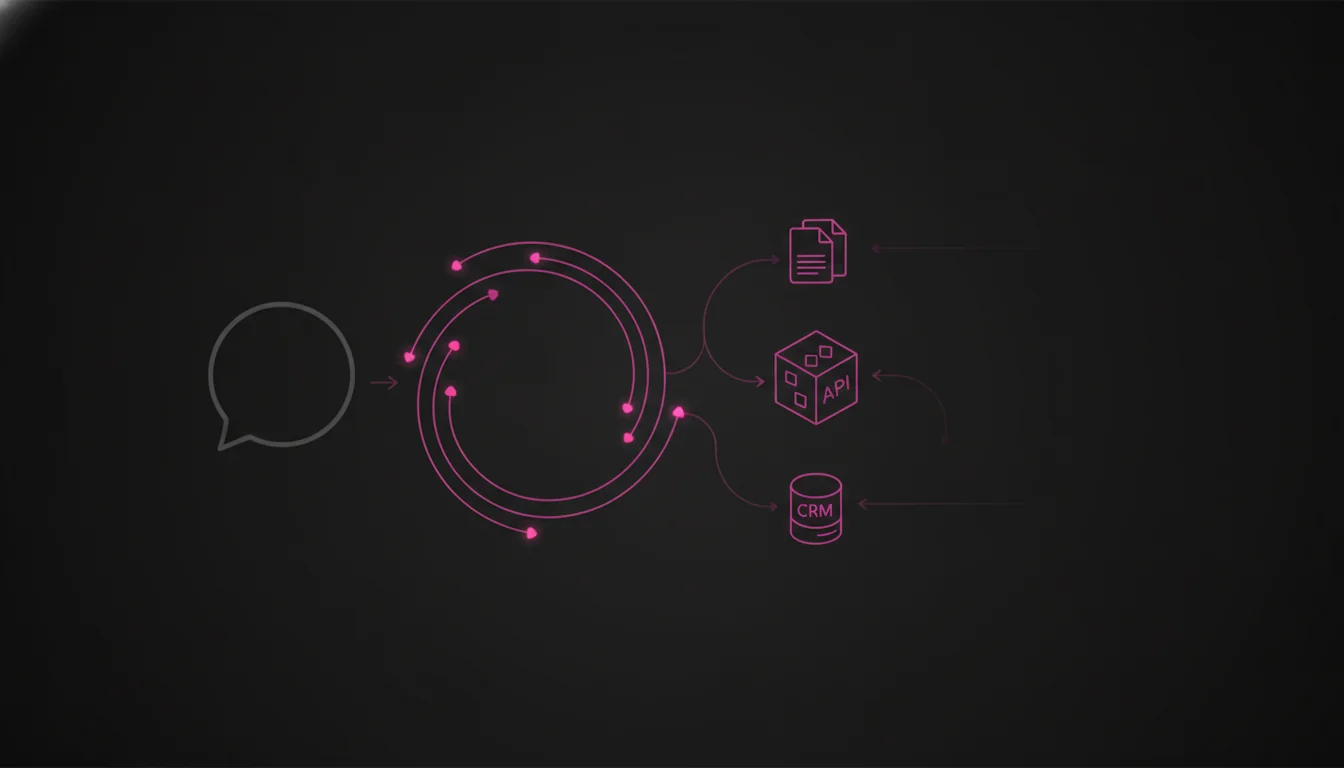
In 2026, for an Italian SME, a custom AI agent put into production typically costs €15,000–€35,000 in setup. A PoC or simple automation often sits at €3,000–€8,000. When the agent must act on ERP/CRM with audit and exceptions, you move toward €35,000–€60,000. Under €5,000 you almost always buy a prototype, not a company system.
This is not a Zendata price list. These are market orders of magnitude, aligned with directories such as Clutch (2026 AI project bands) and with what we see in SME deals. Two quotes that look identical on paper can differ by 2× if one includes SSO, evaluation, and three integrations and the other does not.
Realistic setup bands
| Project type | Setup (order of magnitude) | Typically includes | Typical time |
|---|---|---|---|
| PoC / simple automation | €3,000–€8,000 | 1 workflow, few sources, minimal UI | 2–4 weeks |
| Document assistant in production | €8,000–€20,000 | RAG on documents, auth, citations | 4–8 weeks |
| Production-ready agent (1–3 systems) | €15,000–€35,000 | tools, permissions, logging, monitoring | 6–12 weeks |
| Operational agent on ERP/CRM | €35,000–€60,000 | actions, retries, human-in-the-loop, tests | 3–6 months |
| Multi-agent / regulated | €60,000+ | orchestration, extended audit, high risk | 6+ months |
Sensible first SME projects cluster at €15,000–€35,000: custom, integrated, usable—not only a demo. That matches the 6–12 week partner horizon on a closed scope in build, buy or partner.
An agent is not a more expensive chatbot, not rebranded RPA, and not Copilot plus a connector. Chat vs goal+tools: AI agents vs chatbots. When it is justified vs RPA: AI agents for companies.
A concrete example: reading documents vs acting
Version 1 — internal assistant. Employees searching procedures, contracts, manuals. Indexing + search + authenticated chat. Typical range: €8,000–€15,000.
Version 2 — agent on the process. Same sources, plus CRM/ERP/ticketing: “which customers have invoices over 60 days?”, “draft the offer from this customer’s last quote”, “open a ticket and set priority”. Typical range: €20,000–€40,000, because authentication, data mapping, errors, rollback, and who approves all enter the scope.
On a real dataset of about 16,500 invoices, rules alone closed ~41% of matches; with assisted AI ~61%. The agent makes sense after rules, ERP integration, and a human queue—not instead of those pieces. Figures are in how to measure AI ROI.
What raises the bill (in order)
- Integrations. An agent over PDFs is one thing. Connecting ERP, CRM, email, tickets, and poorly documented APIs is another. Legacy without modern APIs is the line that blows up most often. Channels (API vs RPA vs export) and permissions: connecting an agent to the ERP.
- Read vs act. “How much did we invoice customer X?” is low risk. “Create the order” needs permissions, audit, retries, exceptions. Autonomy can double the work.
- Data quality. SharePoint with duplicate versions, scanned PDFs, and inconsistent permissions is data engineering, not “prompting”. It can absorb a large share of the project.
- Production RAG and evaluation. Chunking, ACLs, citations, regression tests. That is the gap between a demo and 100 users.
- Security. SSO, RBAC, logs. You do not want sales querying salaries because an Excel file was indexed.
- AI Act. From 2 August 2026, transparency and supervision matter. Product FAQs ≠ recruiting or credit (Regulation EU 2024/1689). For many internal assistants extra cost is limited; for high risk it is not. See deployer duties.
On-prem and voice raise the bill further: GPUs, serving, telephony. They are not a typical first project for a mid-size SME.
The model is cheap; engineering is not
OpenAI API prices are public and, at SME volumes, often irrelevant next to build cost. Indicatively:
| Line | Order of magnitude / month |
|---|---|
| LLM APIs (normal SME usage) | €50–€500 |
| Search / vector / cloud | €50–€500 |
| Monitoring | €20–€300 |
| Maintenance and support | €500–€3,000 if there is a retainer |
| Typical total | hundreds to a few thousand € |
An agent with many tool calls and retries burns more tokens than a chat. Still true: you are buying integrations, data, controls, and ownership, not “the model”.
Quotes that are too low—and too high
“Full company AI agent for €2,500” is almost always OpenAI + n8n + a chat. Fine for a test. It is not a production platform.
“Read SharePoint and open Jira tickets = €150,000” is often oversized in 2026: stacks, APIs, and AI coding have compressed the work. A full-time enterprise team for six months on that scope, for an SME, usually does not add up.
Gartner estimates that over 40% of agentic projects may be canceled by 2027 (cost, unclear value, weak controls). The real risk is not only overpaying: it is paying for a pilot that never reaches production (MIT NANDA, GenAI Divide 2025).
Ten questions before you accept a quote
- Do source code and prompts stay yours?
- Can you switch LLM?
- Which integrations are in scope (exact ERP version)?
- Are SSO / RBAC / logs included?
- How are hallucination and regression measured?
- Who approves actions on systems?
- What does infrastructure cost per month at volume X?
- What does post go-live maintenance include?
- Which success metrics are in the contract?
- Who is the internal owner of the agent?
If a €30,000 quote does not answer, it may be expensive. If a €12,000 quote covers them, it may be a bargain.
On measuring return: how to measure AI ROI. If payback is not inside a horizon the company accepts (often under 12–14 months on the right process), either the scope is wrong or the solution is oversized.
FAQ
How much does a custom AI agent cost for an Italian SME in 2026?
For a custom agent in production, a realistic setup range is €15,000–€35,000. A PoC or simple automation often sits at €3,000–€8,000. With more systems or ERP actions, expect €35,000–€60,000. This is not a Zendata price list: these are market orders of magnitude.
Can you get a company-grade agent under €5,000?
You can get a PoC, an n8n/Make workflow, or a document chatbot. Rarely a system with authentication, permissions, logging, and robust integrations.
What do you spend per month after go-live?
For an SME with normal usage, LLM APIs often stay at €50–€500/month. Total run cost (cloud, search, monitoring, maintenance) is typically hundreds to a few thousand euros.
What raises the quote the most?
Integrations, moving from read-only to actions on systems, and data quality. The AI Act weighs mainly on high-risk uses, not on every internal chatbot.
Sources
- Clutch: AI Pricing Guide: project bands and market rates (directory, not an Italian price list).
- OpenAI: API pricing: token cost; usually secondary to engineering.
- Gartner: over 40% of agentic projects at risk of cancellation by 2027.
- MIT NANDA – The GenAI Divide: State of AI in Business 2025: 95% of GenAI pilots with no measurable P&L impact (report PDF).
- European Commission: AI Act framework and Regulation (EU) 2024/1689.
- Zendata experience on SME partner projects (6–12 weeks on a closed scope; document and reconciliation cases cited in the series).
Dig deeper in the series
- Build, buy or partner
- AI agents vs chatbots
- AI agents for companies: when they are justified
- How to measure AI ROI
- From pilot to production
- Connecting an agent to the ERP / accounting system
If you want an honest scope on a real process (integrations, data, what the agent may do alone), we start there—not from a price list. Write to info@zendata.it or visit zendata.it.
Pietro Ciattaglia, CEO of Zendata AI, Rome