
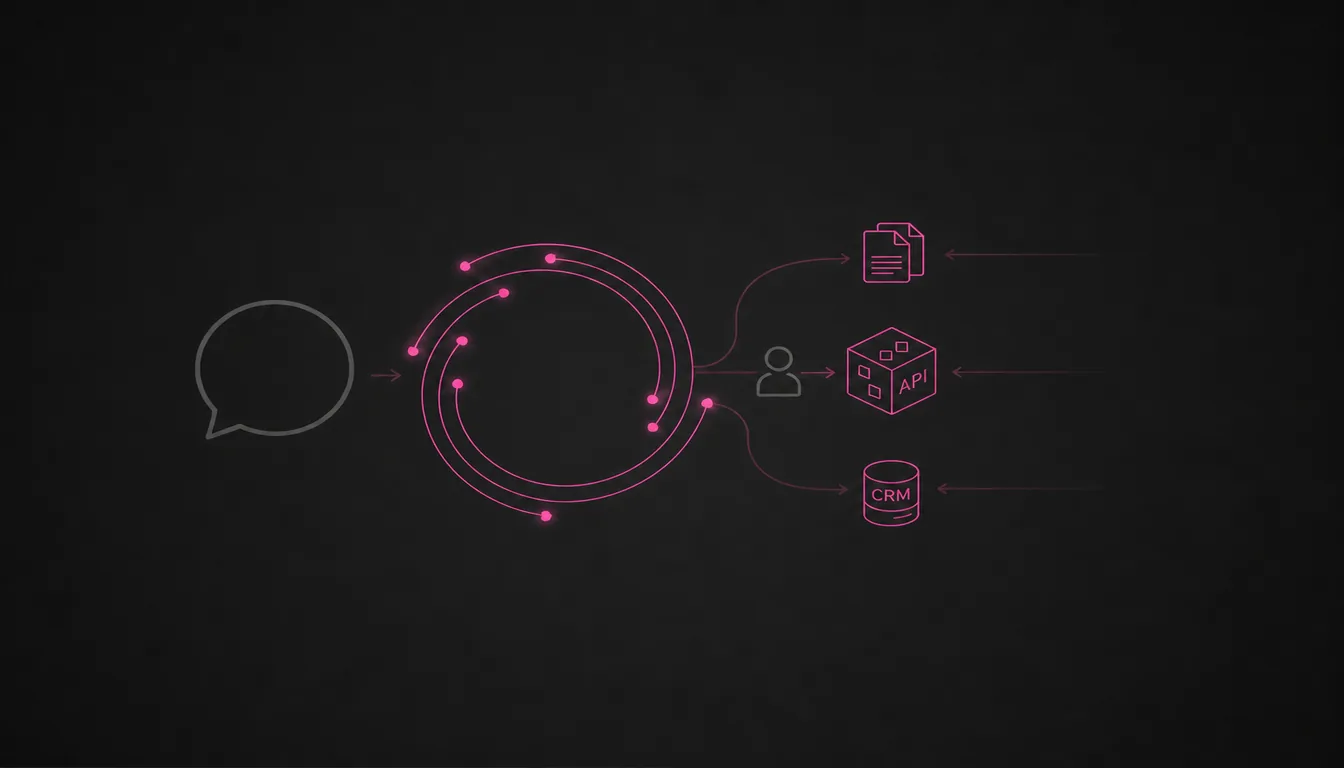
A company AI agent is not a smarter chatbot: it is an automation component to which you delegate a goal and, potentially, permissions. Value depends as much on tools, identity, controls, and audit as on the model. For an SME the sensible first project is usually a single agent, few tools, tight bounds — not a multi-agent orchestra.
The operational difference versus an assistant is in AI agents vs chatbots. Here: what it does, examples, what it costs, when it is justified, what Istat/Eurostat actually measure, and how not to hand the agent admin rights on the ERP.
What an agent is (and what agentwashing is)
A company AI agent is goal-oriented software that uses a model to interpret context and choose steps, can call data and tools, and when authorised executes actions, iterating until completion, stop, or human escalation. Autonomy can be limited and supervised: it does not need to be “fully autonomous” to be agentic.
OpenAI describes agents as systems that complete work in a loop: they use tools, observe the result, and continue until an exit condition. Tools can be read (CRM, PDF, database) or act (messages, record updates). The same family of definitions appears in Google Cloud and the Microsoft Agent Framework.
Gartner labelled agentwashing the habit of rebranding chatbots, assistants, or RPA as agents. In 2026 “ChatGPT” and “Copilot” are not synonyms for chat-only: they can host agentic capabilities. Compare the pattern (user-led vs goal-led), not the logo.
Examples of AI agents in companies
A good agent example always has three elements: messy input, a decision with exceptions, and an action on a system. Without the action it is an assistant; without the exceptions it is a workflow. Typical examples by function, with where the person stays in the loop:
| Process | What the agent does | Where it acts | Human control |
|---|---|---|---|
| Accounts payable | Reads invoices and delivery notes, matches them to orders, flags differences | Accounting system | Approves entries outside tolerance |
| B2B customer service | Classifies requests, pulls history and contract, drafts the reply, opens the ticket | CRM, helpdesk | Sends replies on complaints and discounts |
| Tenders | Extracts requirements from tender documents, checks missing documents, fills the checklist | Document archive | Signature and submission |
| HR operations | Collects onboarding documents, checks completeness, prepares paperwork | HR system | Any decision about a person |
| Management control | Reconciles data from several sources, explains variances, drafts the monthly commentary | ERP, spreadsheets | Report sign-off |
These are process patterns, not client cases with numbers: results depend on volumes and data quality. For a feasibility analysis on real data (invoices and orders) see AI agents vs chatbots; for the technical side, connecting an agent to your ERP.
How much an AI agent costs a company
For an Italian SME a custom AI agent in production typically costs €15,000–€35,000 to set up, plus recurring fees. These are market bands we also use in our own quotes, not a price list:
| Scope | Setup | Timing |
|---|---|---|
| PoC / simple automation | €3,000–€8,000 | 2–4 weeks |
| Production agent (1–3 systems) | €15,000–€35,000 | 6–12 weeks |
| Operational agent on ERP/CRM with actions | €35,000–€60,000 | 3–6 months |
After go-live, recurring costs (models, cloud, monitoring, maintenance) are typically a few hundred to a few thousand euros a month. Price rises with write permissions, number of systems and data quality, not with the model. Detail and questions to ask vendors: how much an AI agent costs (2026).
AI agent vs assistant, chatbot and RPA: how to choose
Adding an LLM to a flow does not automatically make a good agentic case. Gartner (June 2025) predicts that over 40% of agentic projects may be cancelled by end of 2027 (cost, unclear value, weak risk controls). That is a forecast, not an observed failure rate.
| Situation | Evaluate first |
|---|---|
| Answers from procedures/FAQs | Chatbot / search / assistant |
| Write, summarise, advise; a person decides | Copilot / assistant |
| Stable flow: “if X, always run Y-Z” | Workflow / RPA |
| Extract data from invoices or forms | Document AI / IDP, then workflow |
| Unstructured input, exceptions, many sources, path that changes | Agent |
| Read, decide and update CRM/ERP/tickets in several steps | Agent with tools and guardrails |
AI agent vs AI assistant: the assistant (Copilot, ChatGPT in chat) helps a person who stays in the driver’s seat and decides every step; the agent receives a goal and chooses the steps itself, within the permissions you grant. A chatbot is the conversational, reactive version: it answers, it does not execute.
RPA and intelligent agents: when they coexist
RPA still fits repetitive, deterministic work (UiPath on RPA). RPA and an agent can coexist: the agent interprets, the deterministic arm executes. A document case can close with IDP and a human check without agentic autonomy (e.g. SM Supermalls / Document AI: over 80% form accuracy and −67% processing time on ~30,000 forms/quarter — not an agent).
OpenAI recommends maximising a single agent first. More agents add overhead; they help when instructions or tools no longer fit one perimeter (OpenAI practical guide).
Minimum stack to demand in a project: model, instructions/loop, knowledge with provenance, read vs write tools, identity and least privilege, memory/state, guardrails and human approval, traces (model call, tool call, handoff) and evals. Without those pieces you are buying a demo. Setup bands: how much an AI agent costs (2026).
Italian figures measure AI, not agents
Among Istat and institutional sources checked in August 2026, there is no official share of Italian firms that “use AI agents”. Treating Istat’s 16% as “agent adoption” would be wrong.
| Source | Figure | What it actually measures |
|---|---|---|
| Istat, ICT in enterprises 2025 | 16.4% of firms ≥10 employees (8.2% in 2024) | AI in general |
| Same release, SMEs | 15.7% (from 7.7% in 2024) | AI in general |
| Among Italian AI users | 70.8% extract knowledge from text; 59.1% use generative AI | Technologies among adopters |
| Eurostat 2025 | 19.95% of EU firms ≥10 employed | AI in general |
Among EU firms that already use AI, about 31% apply it to administration/management processes. That is a hint about where the work sits, not a measure of agents.
Agent-specific numbers remain private surveys: Capgemini 2025 (1,500 executives in 14 countries) reports 2% deployed at scale and 12% at partial scale — not an Italian SME sample. Gartner forecasts task-specific agents in up to 40% of enterprise applications by end of 2026: that is presence in software products, not the share of adopting companies.
AI agent authorization: identity, permissions, approvals
Authorizing an agent means deciding which identity it acts under, on which objects, with which actions and with which approval. That is where the risk sits: autonomy plus permissions. A practical scale, from safest to most sensitive:
| Level | The agent can | Typical authorization |
|---|---|---|
| 1. Read-only | Read documents and records in dedicated views | Dedicated service account, read scopes |
| 2. Draft | Prepare emails, entries, tickets without sending them | A person approves every output |
| 3. Action with approval | Execute after an explicit yes | Approval on side effects, log of who approved |
| 4. Scoped action | Execute alone on limited objects and amounts | Tool allowlist, thresholds, audit and fast revocation |
With an assistant, a mistake stays text someone can reread. With write tools, the same mistake can become a sent email, a changed record, or an export. OpenAI covers prompt injection and asks you to pause before side effects (guardrails and human review).
Microsoft, on least privilege for AI agents, calls for a dedicated identity, scope, tool allowlists, approval on high-impact actions, and audit of identity, role, resource, action, and correlation ID. Permission creep and shared credentials widen the blast radius of an injection or a bad plan.
Questions you should be able to answer in production: which identity acted? on which object? who approved? what trace remains? If you cannot answer, you are not ready to “act on the ERP”. Metrics: AI ROI.
AI Act: “agent” is not a legal category
The Commission AI Act Service Desk notes the term is not uniformly defined; an agent is still, as a rule, an AI system. Who uses it under their own authority is usually a deployer. Article 4 (literacy) remains in force; Article 50 covers direct interaction with people on the provider side, with extra deployer duties in specific cases — not “a badge on every internal output”. See Art. 50 and the deployer guide.
After the Omnibus in force on 27 July 2026, Annex III high-risk uses (including certain employment uses) move to 2 December 2027. Calling it an “agent” does not make the system high-risk: intended purpose does. A recruiting agent should be designed from day one with logging, human oversight, and classification — not “automatically banned”. In Italy, Law 132/2025 adds no obligations beyond the AI Act, but Art. 11 requires informing workers when AI is used in employment decisions or monitoring. General information, not legal advice.
FAQ
What is an AI agent?
Goal → reasoning/plan → tools → action → check or escalation. Autonomy is a continuum (read-only, draft-only, action with approval, action within scope).
Difference versus ChatGPT or Copilot?
They are products that can include both assistants and agentic modes. What matters is whether the flow is user-led or goal-led.
Agent or RPA?
Fixed rules → RPA. Ambiguity and dynamic tool choice → agent. They often coexist.
How many Italian SMEs use them?
Istat does not say. It says AI in general is at 15.7% among the SMEs it considers in 2025.
Can it read and send email?
Technically yes if it has the tools. Read and send should be separate privileges, with approval on side effects.
How much does it cost?
Market orders of magnitude: €15,000–€35,000 setup in production; detail in the 2026 cost pillar.
Sources
- OpenAI – A practical guide to building agents
- Google Cloud – What are AI agents?
- Microsoft Agent Framework and least privilege for AI agents
- Gartner, agentic project cancellation
- Istat – ICT in enterprises 2025, Eurostat – AI in enterprises
- Commission – AI Act framework, AI agent FAQ, consolidated text
Dig deeper in the series
- AI agents vs chatbots
- How much a custom AI agent costs (2026)
- Connecting an agent to the ERP / accounting system
- MCP vs A2A: AI agent interoperability
- ChatGPT Business vs Plus vs Enterprise
- Microsoft Copilot for companies
- Pilot vs production
- AI ROI
- How companies in Italy use AI: 2026 data
If you want to see whether a process is an agent, RPA, or a governed assistant — and which access to grant — we start from a measurable perimeter. Write to info@zendata.it or visit zendata.it.
Pietro Ciattaglia, CEO of Zendata AI, Rome