
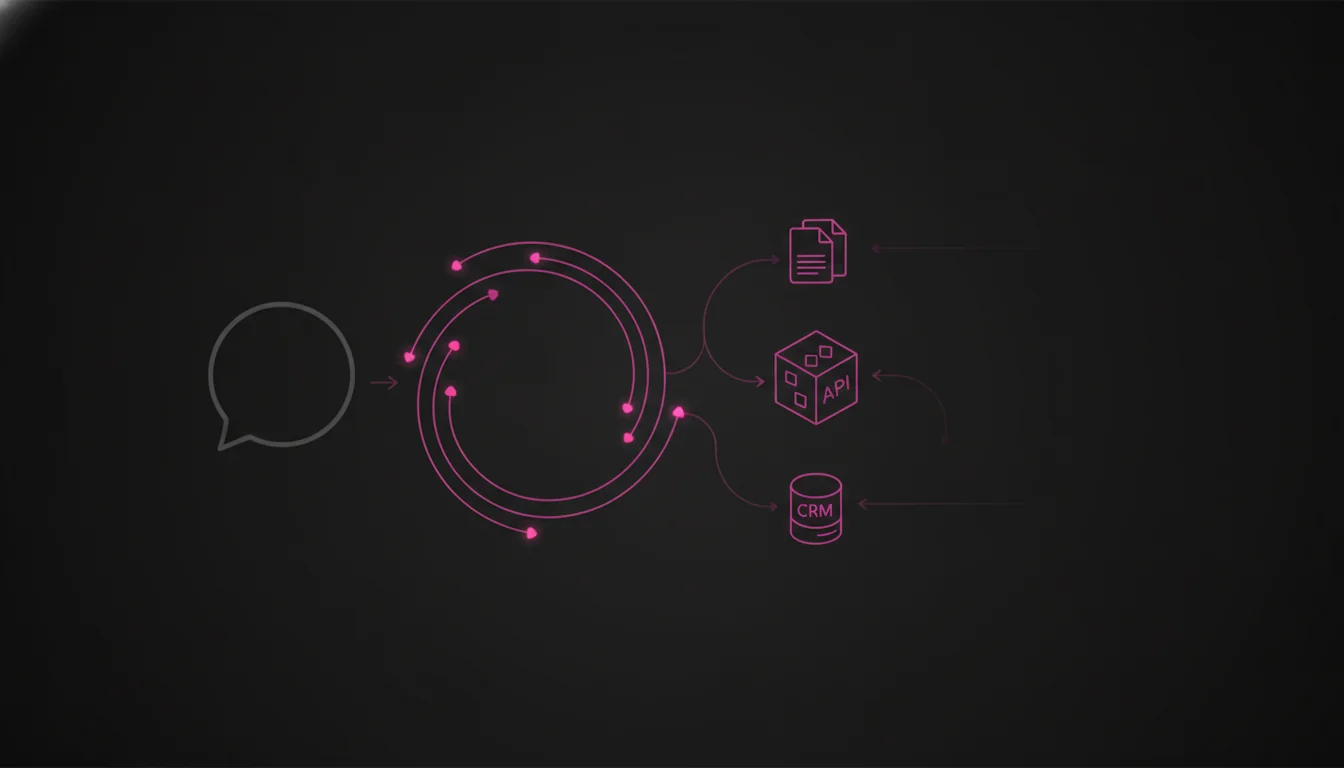
An AI agent is not a smarter chatbot: it is a system that pursues a goal, uses tools, and can take multi-step actions. The difference is not stylistic—it is operational. And it radically changes governance, data, and ownership requirements.
This page covers the difference between chatbots, Copilot and agents. When an agent is justified in an SME — Istat figures, permissions, the AI Act — is in AI agents for companies.
The practical difference in three points
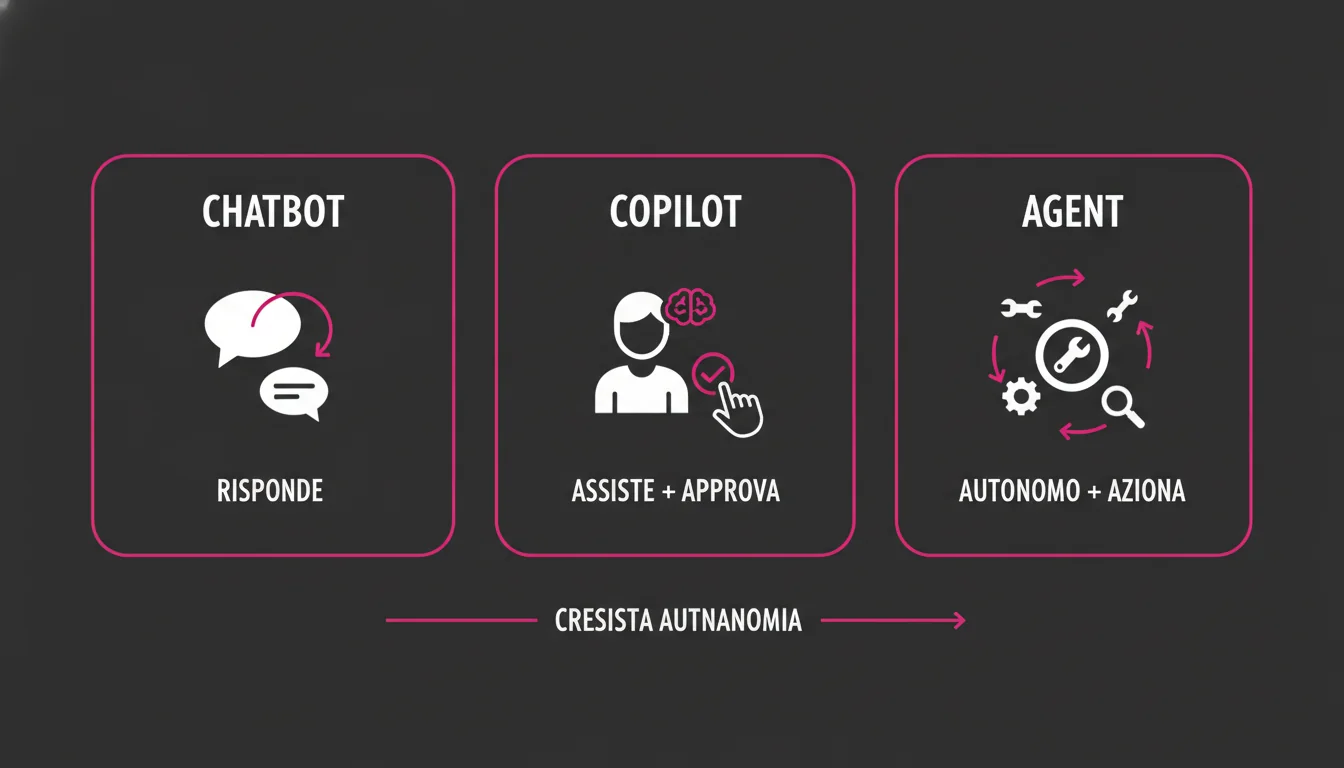
- Chatbot → answers a question, stays in the dialogue.
- Copilot → assists the user in a task, but the final action stays human.
- Agent → receives a goal, plans sub-tasks, calls tools/APIs, iterates, and can close a cycle (or part of it).
According to McKinsey – State of AI, many enterprises experiment with agents, but few take them to production on multi-step processes. Gartner (June 2025) expects over 40% of agentic projects may be canceled by 2027, mainly because of unclear value, costs, and insufficient risk controls. The MIT NANDA / GenAI Divide 2025 report puts at around 5% the share of custom systems that reach production with P&L impact.
When an agent makes sense (and when it does not)
It makes sense when:
- the process has repetitive, clear steps;
- reliable tools/APIs exist (CRM, ERP, document system, ticketing);
- the cost of error is manageable or there is a human checkpoint;
- there is clear ownership of the outcome.
It makes little sense (at least at the beginning) when:
- knowledge is chaotic and not citable;
- stable integrations do not exist;
- the risk of a wrong action is high and unmitigated;
- nobody is accountable for the final result.
In many SMEs the first useful step is still a knowledge system plus governed search/answer. The agent comes later, when the scope is solid.
The four requirements almost everyone underestimates
-
Accessible and up-to-date data and knowledge
An agent amplifies context errors exactly like a weak RAG. -
Reliable tools and granular permissions
If the agent can write or modify, permissions must be tight and auditable. -
Guardrails and human-in-the-loop
Explicit control points before irreversible or high-impact actions. -
Success metrics different from “it works in the demo”
Task completion, human intervention rate, errors, cycle time, value generated.
An anonymized example: when an agent makes sense (and how to measure it)
Case A — invoice/order reconciliation (feasibility analysis on real data).
Perimeter: about 16,500 AP invoices and a similar volume of orders. You do not need a chatbot: you need a workflow that proposes matches, flags exceptions, and leaves closure to the operator.
Feasibility results on that dataset:
- ~41% of invoices closable with deterministic rules alone;
- ~61% including AI-assisted matching;
- 70–74% estimated coverage with assisted proposals + document search;
- ~96% accuracy on the subset with a readable order reference.
Production metrics (beyond feasibility): % auto-match, % in the human queue, average review time, post-closure errors. The agent (or agentic engine) makes sense after rules, ERP integrations, and a review queue — not instead of those pieces.
Case B — agent on a data room / document due diligence.
Goal: check completeness, extract entities, flag risks, draft a report. Sensible metrics: missing-document checklist closed in hours instead of days, % of findings with documentary evidence, human review rate on high-risk findings (100% at the start). Without an ordered corpus and granular permissions, the agent amplifies noise.
In short: agents pay when the process is measurable. If you do not know what to count, you are not ready for autonomy.
How to introduce them without falling into pilot purgatory
- Start from a narrow, high-volume process (e.g. ticket classification + enrichment, recurring report preparation, preliminary request screening).
- Define the objective in business terms, not as “having an agent”.
- Limit available tools and permissions.
- Insert human checkpoints on critical steps.
- Measure adoption and quality with the same rules as any other AI project.
Agents do not replace the need for ordered knowledge, ownership, and measurement. They amplify it.
FAQ
Will agents replace chatbots?
No. They solve different cases. Many processes remain better served by assisted search or a supervised copilot.
Can an SME use agents safely?
Yes, if the scope is small, tools are limited, and someone is clearly accountable for the result. You do not need to start with complex multi-agent systems.
What is the main risk?
Undesired action or error propagation across systems. That is why permissions and checkpoints matter more than the underlying model.
Do you need an AI engineering team?
Not necessarily for the first cases. You need process clarity, accessible data, and a partner or internal team able to integrate and govern.
How much does an AI agent cost for an SME in 2026?
For a custom agent in production, a realistic market setup range is €15,000–€35,000; a PoC €3,000–€8,000; with ERP and actions, €35,000–€60,000. Detail: How much a custom AI agent costs for an Italian SME in 2026.
Sources
- McKinsey State of AI 2025: experimentation and scaling of AI agents.
- Gartner: over 40% of agentic projects at risk of cancellation by 2027.
- MIT NANDA – The GenAI Divide: State of AI in Business 2025: ~5% of custom systems in production with P&L impact.
Dig deeper in the series
- From pilot to production
- AI agents for companies: when they are justified
- How much a custom AI agent costs for an Italian SME in 2026
- Connecting an agent to the ERP / accounting system
- How to measure AI ROI
- Data security and Shadow AI
If you want to assess whether a process in your company is ready for an agent (or whether it is better to stay on knowledge + governed assistant), we can run a focused assessment. Write to info@zendata.it or visit zendata.it.
Pietro Ciattaglia, CEO of Zendata AI, Rome