
For an SME on Microsoft 365, Copilot is the starting point for email, meetings, and documents; Copilot Studio or an agent comes in when you need actions on ERP/CRM; a custom system makes sense when the process itself — not the chat — is the product. Buying Copilot to clone a line-of-business system is often the wrong problem; building an agent to summarise meetings Copilot already handles is waste.
Microsoft prices and naming move quickly. This is aligned with Italian commercial pages and Microsoft Learn checked on 21 August 2026. Reconfirm checkout before you buy. General information, not legal advice. Zendata builds process agents: we do not sell Microsoft licences.
Copilot Chat, Microsoft 365 Copilot, and Copilot Studio are not the same product
Copilot Chat is the included entry point on many eligible Microsoft 365 plans; Microsoft 365 Copilot is the premium work layer; Copilot Studio is the platform for building agents. Mixing them up is the most common procurement error.
Copilot Chat (Entra account, eligible plan: Business Basic/Standard/Premium, E3/E5 and others) gives enterprise-protected chat. Work grounding and the full Word, Excel, PowerPoint, Outlook, and Teams experiences sit on the Copilot licence. Microsoft documents coexistence: Chat for eligible users, full seats only where work context is the value.
Microsoft 365 Copilot uses Microsoft Graph (email, chat, documents, meetings) within the user’s permissions. You do not have to index Outlook and Teams from scratch for summaries and drafts. In 2026 “uses Graph” does not mean “only data already in Microsoft 365”: Copilot connectors can index external sources (synced) or query in real time via MCP (federated). Salesforce has a documented connector; an Italian vertical ERP often does not: you need a custom connector or an API.
Copilot Studio is the agent environment: knowledge, connectors, actions, channels. Microsoft distinguishes declarative agents (Copilot orchestrator) from custom-engine agents (your orchestrator and models, extra hosting). “Custom” can still sit in the Microsoft ecosystem.
Official Italy prices (August 2026)
Comparing €26/user with an agent project without a process is the wrong comparison: one is seat-based, the other is project plus usage.
| Product | Microsoft Italy price (21/08/2026) | Model |
|---|---|---|
| Copilot Chat | €0 extra on eligible plans | Included |
| Microsoft 365 Copilot Business | €18.20/user/month; €15.60 promo | Annual, excl. VAT |
| Microsoft 365 Copilot | €26.00/user/month | Annual, excl. VAT |
| Copilot Studio (capacity pack) | €173.30/tenant/month | 25,000 Copilot Credits |
Sources: Copilot plans, Enterprise, Studio. Business promo: 1 July–30 September 2026, first year, existing customers with an eligible Business plan. A partner channel may show different dates: do not assume an extension from the public site.
Studio credits are tenant-wide. Credits per interaction are not a constant: Microsoft publishes an estimator for that reason. There is no official TCO “Copilot vs custom”: we do not invent one. For an agent in production, market setup orders of magnitude are in how much a custom AI agent costs (2026): €15,000–€35,000 on a typical first SME perimeter.
What Copilot does well — and what is not a process
Copilot is strong on horizontal knowledge work: context already lives where people work. Long threads, missed meetings, drafts from documents, spreadsheet insight, slides from a report: a dedicated agent here duplicates the product.
The limit is moving from understand to execute. SME example: read invoices, check master data and PO in the ERP, price tolerance, exceptions, approval, posting, PDF/XML archive, evidence file. Copilot can read and communicate. Execution needs a system of record, state, errors, and roles.
Microsoft itself positions agents when Copilot alone does not cover workflows, sources, or automations. Agents can update records and orchestrate steps. “It can call an action” is not “the process is reliable”: you still need idempotency, duplicates, rollback, SoD, retries, reconciliation.
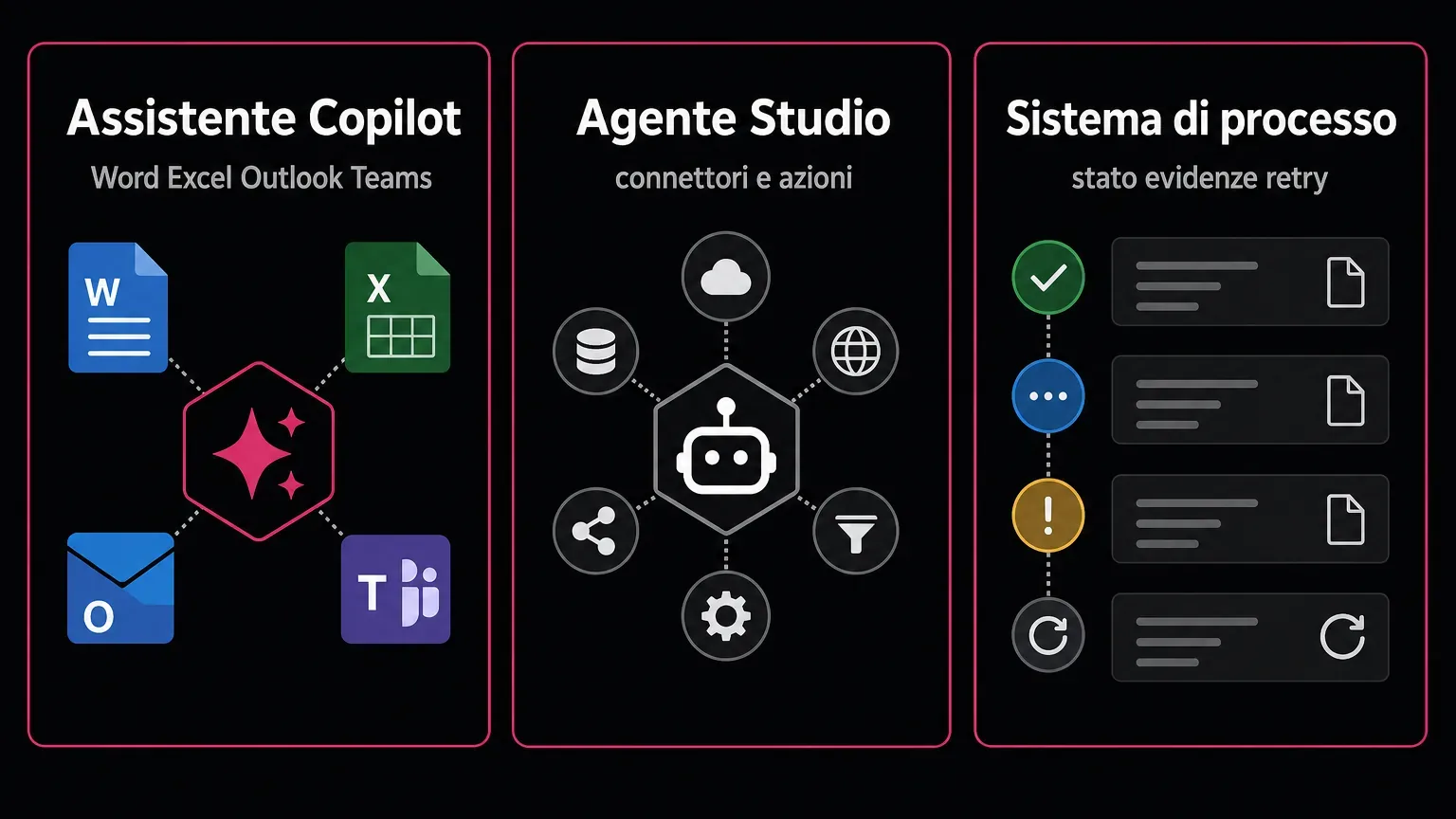
Three levels that can coexist:
| Level | What it does | When it is enough |
|---|---|---|
| Assistant (Copilot) | Search, summarise, draft, suggest | Data in M365; a person decides |
| Operator (Studio / agent) | Tools, connectors, actions, workflows | M365 plus some writes to CRM/ERP |
| Process system | State, rules, transactions, evidence, retries | The case/transaction is the product |
Purview logs prompts, responses, and citations: useful for AI governance. It is not, by itself, proof that invoice X was validated against order Y, approved by Z, and posted as protocol W. That trail has to be modelled in the workflow.
Copilot vs ChatGPT: update the comparison for 2026
The useful difference is no longer “Office vs generic chatbot”. ChatGPT Business has a workspace, connectors, and agentic workflows; OpenAI states no-training-by-default on Business/Enterprise/API. Copilot starts natively from Entra, Graph, SharePoint, and Purview.
On data: Microsoft states that prompts, responses, and Graph data do not train foundation models. Copilot is covered by the EU Data Boundary, with caveats: Bing web search is not the same EUDB treatment; web search can be disabled. Flex routing at peak can move inference if the admin allows it. “EUDB” is not “everything Copilot does stays in one perimeter”.
SharePoint is privileged knowledge for Studio. Copilot does not fix oversharing: it shows what the user can already see. Same pattern as shadow AI: the risk is identity and permissions, not the logo.
When Copilot is enough, when hybrid, when custom-only
The criterion is where data lives, which actions you need, and which evidence must remain. Not the vendor.
| Criterion | Copilot is enough | Copilot + Studio / custom | Process custom only |
|---|---|---|---|
| Data | Outlook, Teams, SharePoint, Office | M365 + ERP/CRM/API | Non-Microsoft / vertical systems |
| Work | Summaries, drafts, meetings, ad hoc analysis | Knowledge + some actions | Defined repeatable process |
| Evidence | Copilot / Purview history | Agent logs + application records | File per case |
| Dominant price | Per-seat | Seat + Credits + integration | Project + infra + API |
| Volume | Many users, variable work | Users + specific processes | Cases/transactions |
A professional firm or commercial SME that lives in Outlook/Teams/Word: start with Copilot (Chat everywhere, full seats on high-use roles). Strong hybrid pattern: Copilot/Teams as front end → agent → API/ERP → approvals → evidence in the system of record. “Custom only” (including Microsoft-based) when the process must run without M365 users, on events, with its own UI, or across thousands of cases.
Cost rule: do not compare headcount with tokens; compare active seats, transactions, and process complexity. Make-or-partner detail: build, buy, or partner. Agent vs assistant: AI agents for companies.
FAQ
Is Copilot included in Microsoft 365?
Copilot Chat yes, on eligible plans. Work grounding and premium apps no: you need Copilot or Copilot Business.
What does it cost in Italy in 2026?
€26.00/user/month (Copilot, annual); Business €18.20, promo €15.60 until 30 September 2026. Studio €173.30/tenant/month for 25,000 credits. Excl. VAT; check checkout.
Copilot or ChatGPT?
Copilot if work is Microsoft 365. ChatGPT Business if you need a cross-platform AI workspace. No universal winner.
Can it read every document?
No: only what the user can already open.
Does it train on company data?
Microsoft says no on foundation models. Chats are stored. Web search is a different perimeter.
Can it close an ERP process?
With agents and integrations, in part. Reliability, state, and the evidence file are designed; they do not arrive with the licence.
When a custom agent?
Process on systems of record, actions, exceptions, per-case audit. SME setup range: €15,000–€35,000.
Sources
- Microsoft 365 Copilot plans and pricing (IT) and Copilot Business
- Microsoft 365 Enterprise plans (€26.00/user/month)
- Copilot Studio pricing and billing on Learn
- Agents overview, Copilot connectors
- Enterprise data protection, Copilot Chat privacy / EUDB
- Flex routing
Dig deeper in the series
- ChatGPT Business vs Plus vs Enterprise
- AI agents for companies: when they are justified
- AI agents vs chatbots
- How much a custom AI agent costs (2026)
- Build, buy, or partner
If you are deciding whether to buy Copilot, extend it with Studio, or build an agent on your ERP, we start from one concrete process (data, actions, evidence). Write to info@zendata.it or visit zendata.it.
Pietro Ciattaglia, CEO of Zendata AI, Rome