
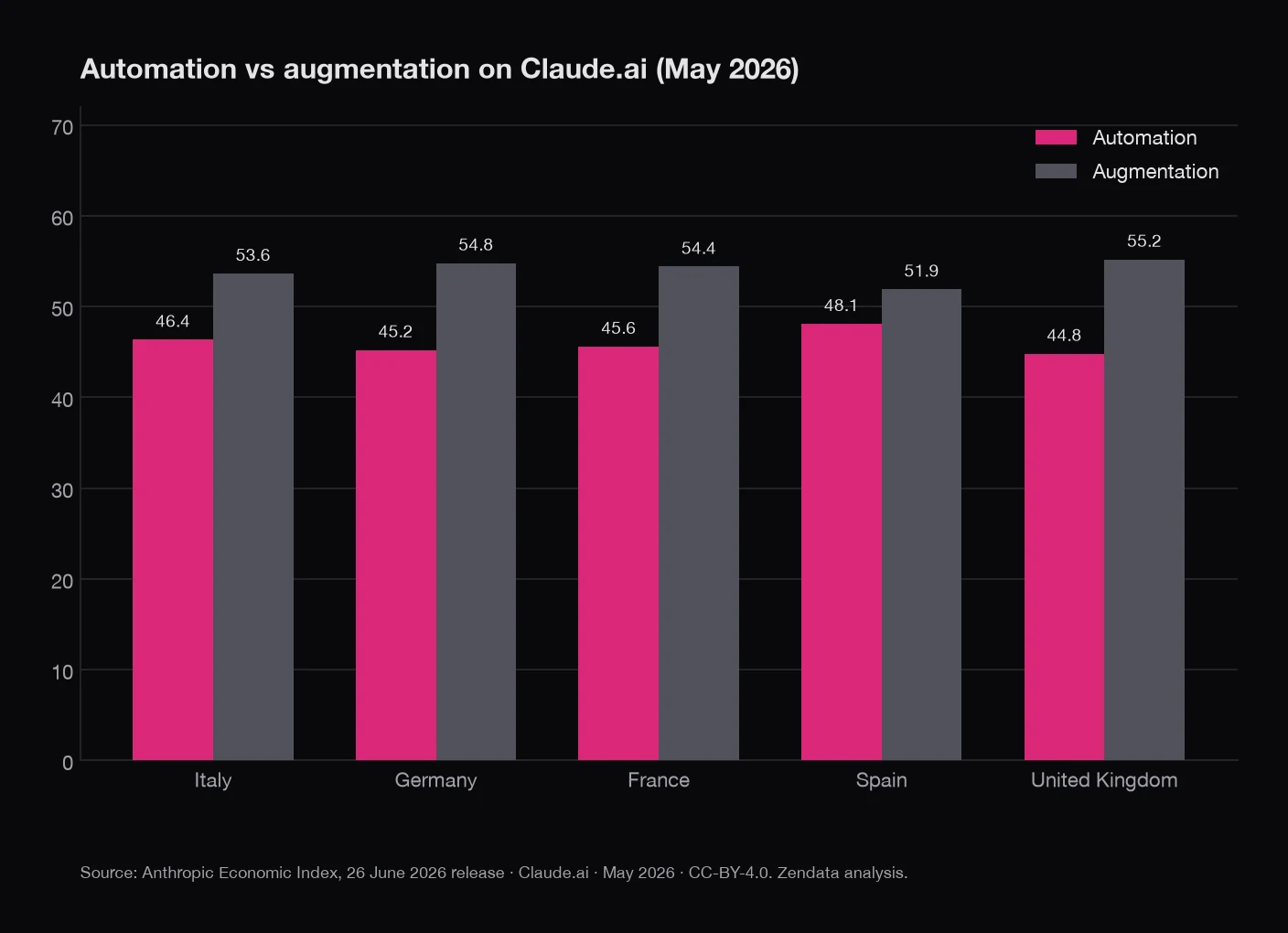
In Italy, in May 2026, 53.6% of Claude.ai conversations are augmentation (the user works with the model) and 46.4% are automation (the user delegates the task). The work share (42.9%) is higher than in Germany, France, and the UK. The Italy cut of the Anthropic Economic Index is observed, not self-reported: it is not a survey.
What the dataset is, and why it is not a survey
The Anthropic Economic Index classifies real Claude conversations, not questionnaire answers. From 2025 the data are broken out by country: Italy’s geographic code is ITA. The 26 June 2026 release covers April and May 2026 on Claude.ai (chat and Cowork).
A survey asks “do you use AI?”. Here you see what people ask the model, whether the interaction is directive or iterative, and what kind of output comes out. Anthropic does not claim the dataset represents AI use in general: it is a Claude sample, with privacy-preserving aggregation and minimum volume thresholds.
License: CC-BY-4.0. Attribution: Anthropic Economic Index, Cadences report (26 June 2026) and the Hugging Face dataset. Charts: Zendata analysis.
The Italy chart: automation vs Germany, France, Spain, UK
In May 2026, Italy’s automation share is 46.4%. Simple average of the five countries: 46.0%. There is no Italian outlier on automation. There is one on work.
| Country | Automation | Augmentation | Work share |
|---|---|---|---|
| Italy | 46.4% | 53.6% | 42.9% |
| Germany | 45.2% | 54.8% | 37.6% |
| France | 45.6% | 54.4% | 34.2% |
| Spain | 48.1% | 51.9% | 42.3% |
| United Kingdom | 44.8% | 55.2% | 39.0% |
Automation = directive + feedback loop. Augmentation = learning + task iteration + validation. In Italy in May, task iteration is the most common pattern (31.3%); pure directive mode is 28.3%.
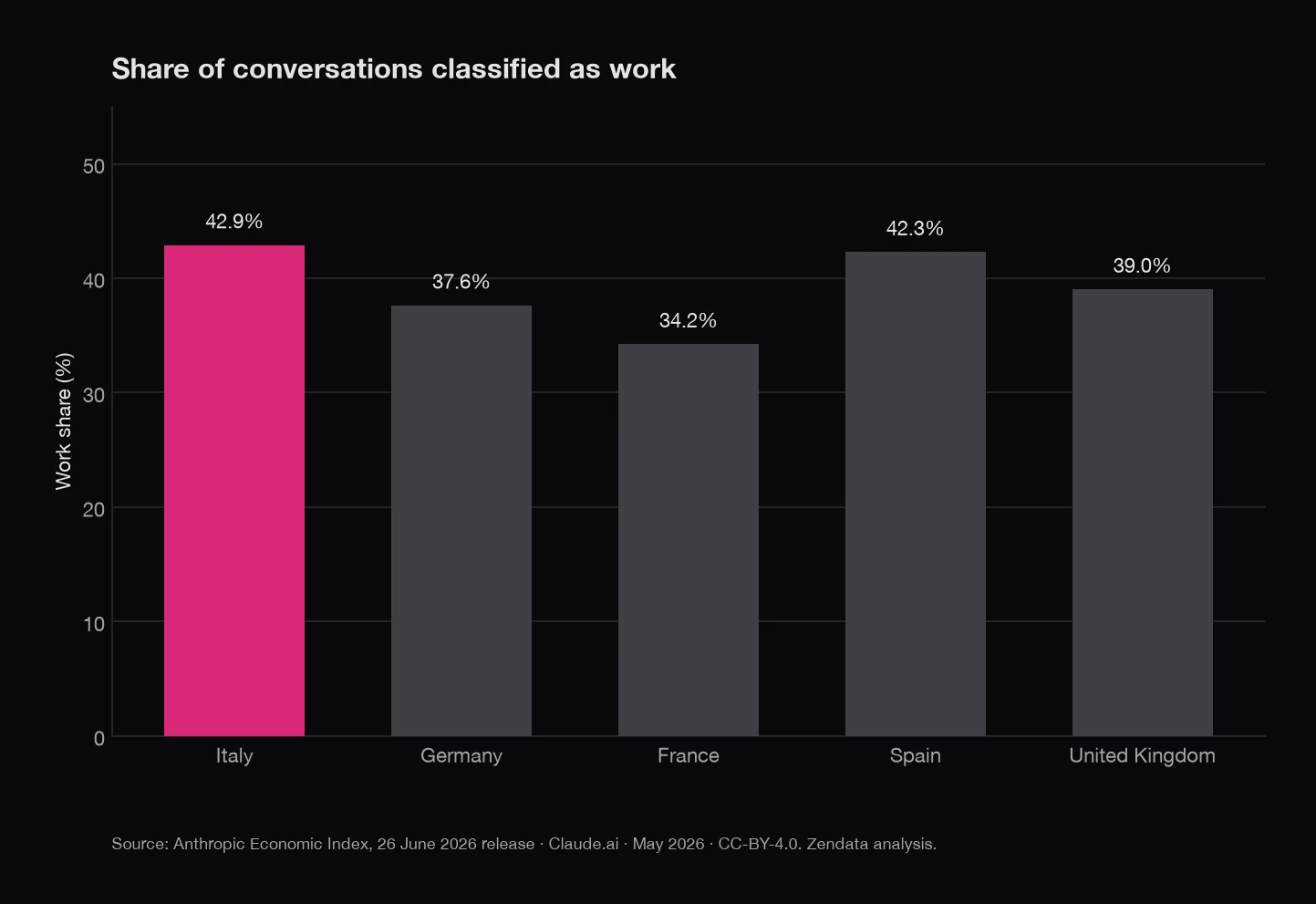
In April 2026 Italy’s work share was even higher (46.5%). The peer gap is the same: Italy uses Claude in a more office-like way than Germany and France, with lower usage per capita (Anthropic index 1.70 in Italy vs 3.97 in France). Less volume, more work.
The tasks people delegate, mapped to documents, HR, accounting, and tenders
In the global June report, the classifier found an artifact in 93% of conversations. The most common: explanations (17%), documents and reports (15%), guidance (11%). In work conversations, documents and reports rise to 20%, then explanations (9%), email drafts (7%), analyses and summaries (6%).
That is a product fact, not a slogan: a large share of AI work is document production.
In the Italy cut (May 2026, most granular request clusters) the visible office tasks are:
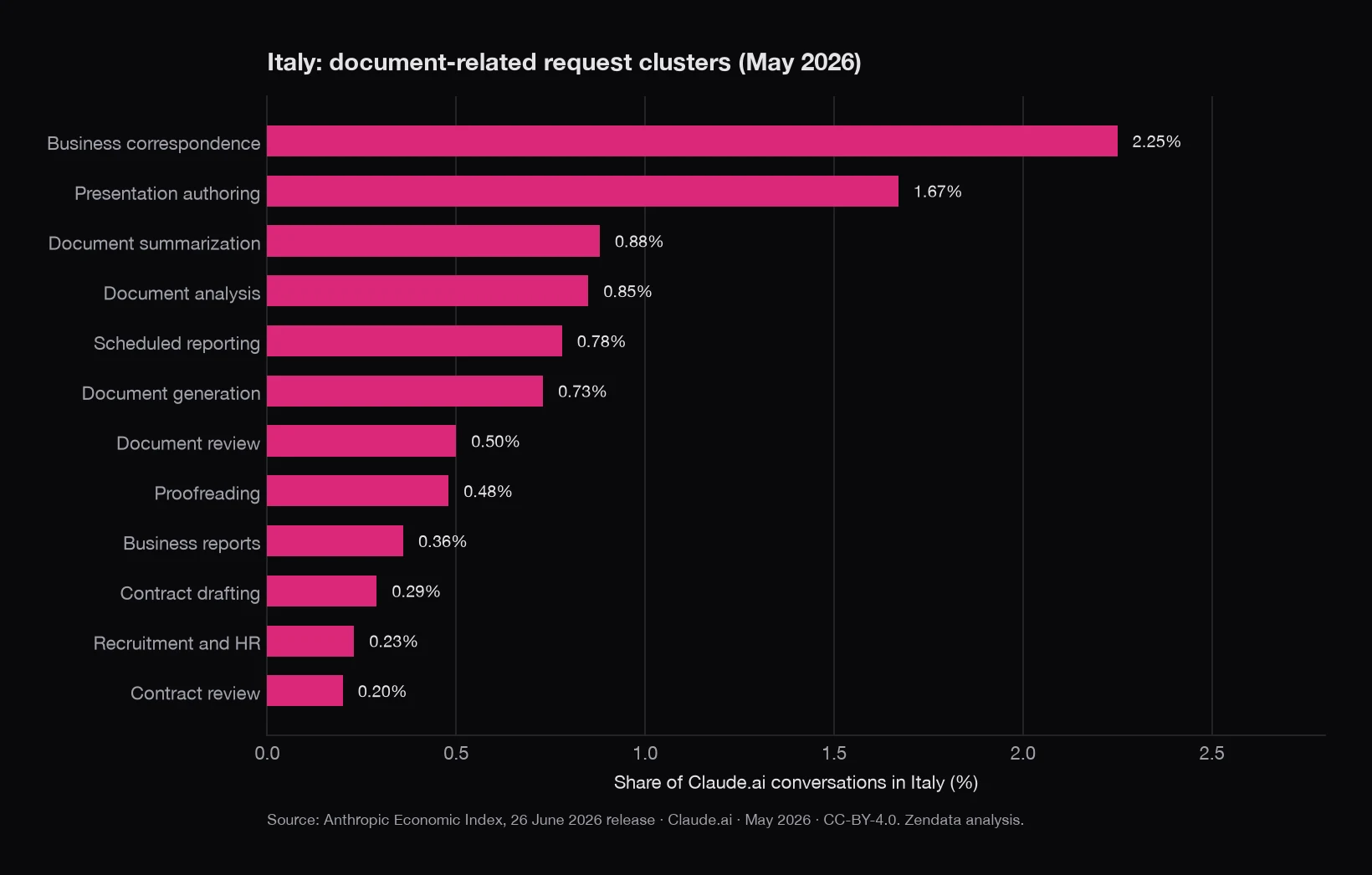
- Business correspondence (2.25%) — workplace email and letters.
- Presentation authoring (1.67%).
- Document summarization and analysis (0.88% + 0.85%).
- Scheduled reporting and document generation (0.78% + 0.73%).
- Review, proofreading, business reports.
- Recruitment and HR (0.23%) and contracts (drafting 0.29%, review 0.20%).
- Taxation (0.38%) — a weak but present signal, consistent with deadline spikes described in the report (in the US sample, around 15 April).
Clusters are fragmented: none takes 10% on its own, aside from study and wellbeing (personal/coursework). The long tail is the point. For an SME the useful verticals are not “AI in general”: they are mail, slides, reports, contracts, a slice of HR.
Tenders and public bids do not show up as a named top cluster in Italy. That is a limit of the O*NET/request vocabulary, not proof the work does not exist. If your process is “data room + checklist + draft bid”, the closest mapping remains documents, reports, and contracts.
Automation vs augmentation: what it means if you are buying an agent
Automation, in Anthropic’s definition, is delegation with little input: “translate this”, “fix this email”. Augmentation is collaboration: the user iterates, learns, validates.
Two global figures from the report are for the buyer, not for hype.
-
Agent ≠ chatbot. The median chat conversation that produces a blog post or article has 13 rounds of back-and-forth. The median Claude Code session producing the same kind of output has a single human prompt. Same artifact, different cadence.
-
On high-wage tasks the human does not leave. In conversations mapped to higher-wage occupations, Claude produces 1.34 times as much output per turn, and users take 1.53 times as many turns. More model production together with more human effort: the pattern looks like augmentation, not substitution.
For an SME: if the value sits in the document (contract, report, bid, HR file), an agent makes sense when it closes a cycle with evidence and a checkpoint. A chatbot that “talks about the document” is not the same product. We cover the distinction in AI agents in the company.
What to do on Monday morning
- List the three documents you ship every week (report, standard email, tender checklist, expense notes, minutes). That is the scope—not “adopt AI”.
- For each one, decide whether you want augmentation (draft + human review) or automation (delegation with rules and an exception queue). Italian Claude data still show collaboration winning.
- Measure three things: cycle time, human correction rate, actual use of the output. The framework is in how to measure AI ROI.
- If knowledge is scattered across folders and inboxes, start there: document management and AI.
Zendata builds agents on document-heavy processes (HR, accounting, tenders, M&A), with controls and evidence. If you want an assessment on one process only, write to info@zendata.it or see Services.
Methods and limits
Country figures, 26 June 2026 release, Claude.ai conversations from May 2026:
- file: aei_claude_ai_2026-06-26.csv
- Italy: geo_id ITA, geo_level country, category overall
- peers: Germany (DEU), France (FRA), Spain (ESP), United Kingdom (GBR)
- request clusters: same file, Italy, hierarchy_level 0
Charts are Zendata elaborations.
Limits, stated because they matter:
- This is not a sample of AI in Italy. It is Claude.ai. Users of other models are not in the file. Anthropic says the dataset does not represent AI use in general.
- Coding is likely over-represented, because Claude is also positioned as a software model. O*NET software-modification tasks remain visible in the Italy cut.
- The classifier is wrong sometimes. The huge number of distinct tasks makes it possible for some conversations to be mislabelled (Clio / artifact and collaboration classifiers). Cells below volume or privacy thresholds are unpublished: a missing row is not a zero.
- Work vs personal is an automatic classification, not a user declaration.
- Global artifact figures (93%, 20% documents in work conversations, 13 turns vs 1 prompt, 1.34× / 1.53×) come from the Cadences report, not from the Italy CSV alone. We do not attribute them to the Italian cut.
Stating the limit before a CFO or an IT manager points it out is the point. This is not a “+350% average ROI”.
FAQ
Does the Anthropic Economic Index measure AI use across all Italian companies?
No. It measures sampled Claude.ai conversations (chat and Cowork), geolocated. It is not a representative sample of ChatGPT, Gemini, or other tools, nor of the Italian economy.
In Italy, is AI used more for automation or for collaboration?
In May 2026, in the Italy cut, augmentation is 53.6% and automation is 46.4%. In line with Germany, France, and the UK; Spain is higher on automation (48.1%).
Which figure matters most for an SME evaluating an AI agent?
In work conversations, globally, one output in five is a document or report. In Italy, correspondence and presentations are among the most visible clusters. Observed AI work is largely document production.
Why can Zendata cite these numbers?
CC-BY-4.0 dataset on Hugging Face, with attribution to Anthropic. Charts are elaborations of the CSVs, not screenshots.
Sources
- Anthropic Economic Index report: Cadences (26 June 2026) — artifacts, chat vs Claude Code cadence, higher-wage occupations.
- Anthropic/EconomicIndex dataset on Hugging Face — country CSVs, CC-BY-4.0.
- 26 June 2026 data documentation — geo_id schema, collaboration and artifact metrics.
Read more in the series
- AI agents in the company: what changes versus a chatbot
- Document management and AI
- How to measure AI ROI
- AI and work: roles and skills
If you want to read your processes (not global averages) on documents, HR, or tenders, we start from a measurable scope. info@zendata.it
Pietro Ciattaglia, CEO of Zendata AI, Rome